
Okay but like, if global trade were a high school cafeteria, Canada, India, and the EU are very clearly rearranging their seating chart—and the United States is suddenly not the only table anyone wants to sit at.
Let’s start with Canada, which has finally said out loud what everyone’s been whispering for years: sending 98 per cent of our energy exports to the U.S. is, quote, a “strategic blunder.” That’s Energy Minister Tim Hodgson, speaking in Goa at India Energy Week, casually dropping the kind of truth bomb that makes trade nerds gasp and pipeline lobbyists clutch their pearls. His logic? Simple. The fastest-growing energy demand on Earth is in India, not America, and Canada would like a slice of that very large, very hungry pie.
Analysts are fully nodding along. India already refines about six million barrels of crude a day, has big petrochemical ambitions, and could happily swap some Iraqi heavy crude for Canadian oil without breaking a sweat. Right now, Canada ships roughly 150,000 barrels a day to India—basically one Very Large Crude Carrier a month, usually via the U.S. Gulf Coast. Translation: it’s possible, but it’s awkward. Like borrowing your ex’s car to go on a date.
Build a pipeline to a deepwater port, analysts say, and suddenly India becomes a direct, grown-up, no-middleman market. Especially as China’s oil demand starts to plateau, India keeps popping up as the next big engine of global energy demand. Add LNG to the mix—India imports about five per cent of the world’s supply—and suddenly this isn’t just a flirtation, it’s a long-term situationship.
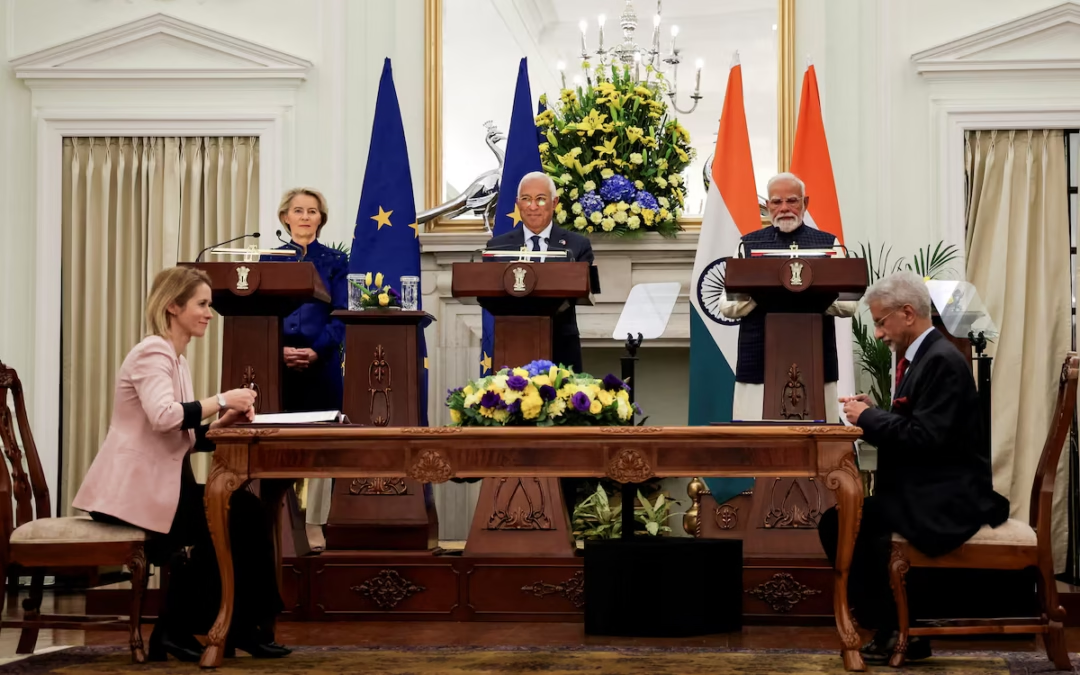
And while Canada is eyeing India with energy-export heart eyes, the European Union has gone full commitment mode, clinching what Ursula von der Leyen herself called the “mother of all deals” with New Delhi after nearly 20 years of will-they-won’t-they negotiations. This free-trade agreement covers almost all goods, slices billions in tariffs, integrates supply chains, and affects up to two billion people. Casual.
Prime Minister Narendra Modi framed it as a stabilizing force in a chaotic global order, while von der Leyen called it a “win-win” between two giants. Trade between India and the EU already hit US$136.5 billion, with ambitions to reach US$200 billion by 2030. And yes, European wine tariffs in India are dropping from a jaw-dropping 150 per cent to 20 per cent, so sommeliers everywhere can finally exhale.
But let’s not kid ourselves: this isn’t just about commerce. This is about de-risking from America—not decoupling, not a dramatic breakup, just a very polite, very strategic diversification. Washington’s aggressive tariff spree, threats over Greenland (still wild), and general “my way or tariffs” energy have pushed middle powers to quietly look around and say, okay, but what if we had options?
Canada sees it. India sees it. Europe definitely sees it. These countries aren’t anti-U.S.; they’re just done putting all their geopolitical eggs in one very unpredictable basket. The EU even has a name for it—“strategic autonomy”—which is diplomatic speak for “we love you, but we’re not financially depending on you like that anymore.”
So yes, India is becoming the new global trade crush, Canada wants in with oil and gas, Europe has locked down a long-term deal, and America is learning—in real time—that being the main character forever is not guaranteed. Middle powers are growing up, spreading risk, and building parallel lanes.
And honestly? From where they’re sitting, that just looks like smart energy.
XOXO,
Valley Girl News
Watching the global order quietly change outfits without making a scene


